
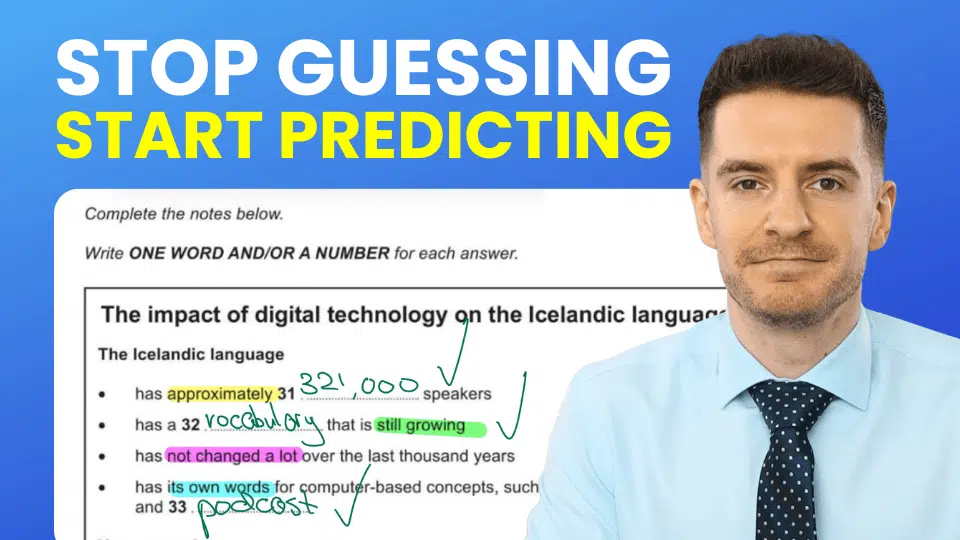
IELTS Reading Section 3 Practice (The Hardest Part)
In this lesson:
✅ IELTS Reading Section 3
✅ How to answer matching headings questions
✅ How to answer multiple choice questions
✅ How to answer note completion questions
✅ General strategies for IELTS Reading
✅ How to answer matching headings questions
✅ How to answer multiple choice questions
✅ How to answer note completion questions
✅ General strategies for IELTS Reading
Full transcript
Welcome to the final section of the IELTS reading test. And it’s usually the hardest. The language is more difficult, the IDs are more complex and time pressure can really start to build. In this video, I’m going to walk you through a full section three step by step, showing you exactly how to handle some of the toughest question types, especially matching headings and multiple choice.
But before we get started, if you’re preparing for IELTS, make sure you check out our preparation course in the description below, because it’s going to teach you everything you need to know to get a band seven or higher in every single part. All right, let’s have a look at our reading section three. Okay, so on the screen now you can see our reading section three.
It’s called Beavers return to the Netherlands after more than a century. So it’s going to be about beavers Netherlands and maybe a little bit of history as well. Now there’s no real need to skim the passage before you look at the questions. You can if you want, but for the purposes of this lesson, we’ll go straight down to the questions.
And here they are. So the first set of questions we’re going to look at is matching headings. So let’s have a look. Questions 28 to 33. The text on the previous pages has six sections A to F. Choose the correct heading for each section from the list of headings below. Pretty simple right? The correct number 1 to 8 in boxes 28 to 33 on your answer sheet.
Now, just something to note. Okay. It says write the correct number so you don’t need to write the full heading. You just need to write the number. Now when you’re doing matching headings questions, you can have a quick look at the headings first. It’s really up to you. So that’s what we’ll quickly do. And we’ll just quickly think about the main idea for each heading.
So first one hope in hard times. Beavers causing action to increase public awareness. An expensive project small amounts of interest, mixed reactions, you know, different feelings to a project, a scientific breakthrough in breathe. Sorry, Beaver. Breeding creatures once seen as trouble. A one scene that could or that is referring to the past but now seen as useful.
Okay, great. The hope that beavers will bring people closer to nature. And evidence that a project, is working. So now we’ve got a basic idea about what these headings are about. So let’s go back or. Sorry. Let’s go. We start with question number 28. And question number 28 is about section A. So let’s go back up to section A.
And when you’re doing this what I recommend you do is you have a quick scheme of the paragraph. You think about the main ideas or the general message or general idea of that section or paragraph. And then you give a name to that paragraph, and then after you’ve given a name, you come back down and you choose the most appropriate heading.
So let me show you what I mean. So we’ll do the first one together. So a, the last time beavers were seen. Okay. Early 1800s. No one can say why they disappeared. Okay? They were hunted fair enough. Why? Their fur, their oil, etc.. Maybe we hunted them to extinction, but they may have been a deeper reason.
Beavers build their dams, slow rivers, flood fields, change the flow of water. So these appear to be negative things about beavers. As farming expanded, beavers build dams. Okay. So beavers build dams. They can flood these areas. So they came to be seen as a threat. Okay, so maybe this paragraph is about the negatives of beavers.
By the time the 20th century arrived. Okay, so we’re moving forward in time. And in today, talking about present times, the beaver is now making a return not just as a symbol, but also a helping hand. An animal that may support Baba, Baba, Baba. So after reading this, paragraph, it looks like they’re talking about the past and the present here.
So, for example, they’ve talked about, in the past, what they were doing. Okay. They were doing these things and they were talking about what happened with farming. And then they said these beavers were a or seen as a threat to, human progress rather than a species to protect. So it looks like it’s saying that in the past we didn’t really like beavers.
And then it moves on to talk about today and it says now beavers can be quite helpful. So for example, they can be you or they can be a helping hand. They can do this through this and do this. So if I had to give a title or a name for this paragraph, it could be something like past and present.
Okay. Because we’re talking about the past and the present. Or it could also be something like negatives. Two positives okay. Because it started out as people feeling negative towards beavers, but now it’s changed. So now we’ve got a title. Let’s go back down to the list of headings and we can choose the most appropriate one. So let’s start with the first one A sign of hope.
Well no doesn’t talk about that. Beavers causing action to increase public awareness. No it doesn’t really talk about that, an expensive project. No mixed reactions to a project. No, a scientific breakthrough. Definitely no creatures once seen as trouble. But now seen is useful. This looks very good. It was a very, very good, the hope that beavers will bring people closer to nature.
No, don’t think so. An evidence that a project is working? No. So it looks like the answer for that one will definitely be six. So we can cross off number six now. So when we come back, we will have less, options to choose from. So let’s move on to the next question, which is of course, 29.
And we’re looking at section B. So we’ll go back up and we’ll do exactly the same thing. We’ll think about the main ideas and give the paragraph a title here. So after an incredibly long absence excitement a pair of beavers were spotted. Okay. Cameras captured. Okay. Signs of a dam began to appear. That might be important.
I know. Offspring or no babies. I know, you know, young beavers were spotted. These beavers, a young okay, the sighting marks a key moment for a reintroduction effort. Now, I remember one of the headings was talking about a project. Actually, I think two of them were. So a reintroduction effort is, you know, it has a similar meaning to project, so it could be related to this one.
In the 1980s, a small group of beavers were brought over, released carefully. So this is just details about that project. Since then, the numbers have grown. Okay. This this. Sorry. The person you see are thought to be a second or even third generation. Okay. One individual. Okay. And then it’s just giving an example. So, for this one, I think the main idea is about that project.
So maybe we could call it something like beavers from a project. Okay. Because that’s the main idea. It’s talking about those beavers from that project. And it’s saying that this project seems to be working because it says the numbers have grown steadily. So it’s talking about the positive things. It’s not saying that it’s not working. So let’s go back down and we’ll see if we can find the most appropriate heading here.
So a sign of hope in hard times. No, causing action to increase public awareness? No. An expensive project? No, it does talk about a project, but there’s nothing about, how much it cost. Mixed reactions. No scientific breakthrough? No. The hope that beavers will bring people closer to nature. No, evidence that a project is working. Yes, that looks very, very good, because the paragraph talks about that project and is saying that, the numbers of beavers are increasing.
So, number 29 will definitely be eight. So we can put that in there and then we can cross this out. So again we’ve got less headings to choose from when we come back for 20 or sorry 30. So yeah. Moving on to question 30 now which is section C. So let’s go back up. Here we go.
This is a much shorter paragraph, so it might be a bit easy or easier for us to find the answer. So let’s have a look at the main ideas. So in a time when environmental headlines are dominated by rising sea levels, declining wildlife. So that’s talking about some negative things. The quiet success that’s positive, of the beaver is a bit of good news.
Concerns over climate change, stories of recovery offer a different kind of energy. Speaking about the project this, earlier this year, one Dutch ecologist called it a small but meaningful turning point in how we manage our landscapes. So it looks like, you know, it’s saying that there are a lot of bad things happening, in this time.
But now we’ve got one good thing. The success of The Beaver. So that’s what I’m going to call it. I’m going to call it one good thing in Bad Times. That’s going to be my title of this, paragraph. Now let’s go back down and see if we can find something similar or suitable. So a sign of hope in hard times.
Well, that looks quite good, doesn’t it? Because we, mentioned that there were some negative things happening. Climate change, wildlife decline. So these are negative things, these, you know, problems. But the sign of hope is that the beaver, project is working well. So this looks good, but let’s just quickly look at the other ones.
Beavers causing action to increase public awareness. No expensive projects, no mixed reactions, no scientific breakthrough, no. The hope that beavers will bring people closer to nature? No. So we can confidently say there that number 30 will be one. So again, we can cross that off because we’ve used that one. Now let’s move on to question 31. And question 31 is about section D.
So let’s go back up. Excuse me and let’s have a look. Now this section has two paragraphs. So we’re going to have to look at both paragraphs and decide on one name for both paragraphs. So the return of the Beaver hasn’t been without resistance okay. So this is maybe a negative thing. Some water boards were cautious.
Okay? The beavers could block drainage systems so the beavers could cause problems. A few farming groups voiced concerns. Okay, the Dutch wildlife advisory board. Not everyone was convinced. Do beavers truly belong in this really heavily managed country? So it seems like it’s talking about organizations which are not sure about this project. Let’s keep going. So how did the reintroduction of beavers gain momentum?
Well, what sets it apart? Early progress, commitment of small local organizations, passionate individuals who believe the project, could be very beneficial. Now, I remember one of the headings was about mixed reactions. So this could be it. In the early years, volunteers helped monitor okay support from nature groups previous success. Rotterdam Zoo played a quiet but crucial role.
Okay, so you know, after looking at this one, it looks like, you know, up here they’re talking about the people who are or the organizations who are a bit cautious, who are not sure. But then down here, it’s talking about the organizations or the people who believe in this project or who support this project. So I’m going to call this one some, cautious, okay.
Some are not sure and then some, believe in it. Okay. Some support, this project, this thing. So let’s go down now and we’ll see if we can find, the best heading. So Beavers causing action to increase public awareness. No. An expensive project, no mixed reactions. Well, yes, we talked about that. That looks really, really good, a scientific breakthrough.
Now, the hope that beavers will bring people closer to nature. Know nothing about hope. So it looks like the answer for 31 will be number four. So again we can cross that one off. And let’s move on to the next question now which is 32. And that is regarding section E. So let’s scroll back up and we’ll have a look.
So across Europe okay. So that might be the topic. Wetlands that are there, there. Okay. The beaver went largely unnoticed. Some rural communities their return is sparked emotion okay. Or feelings. One elderly man spoke of seeing a beaver cat, a memory he thought was buried. So maybe it’s talking about feelings of the locals. In parts of Germany and Austria, signs now mock beaver crossings.
Slovenia primary schools have added beaver themed lessons. In the Netherlands, community groups have started guided walks to help spot gnawed tree trunks and dams. So what began as a cautious experiment has turned into something joyful, a symbol of healing. So it looks like this one is just talking about the result of beavers coming back because it’s giving us, sorry, coming with an eye, coming back because it’s giving us some examples.
It’s talking about what’s happened in Germany and Austria, these beaver crossings. It’s talking about schools okay. Schools have now got lessons or beaver themed lessons. And then it talks about the Netherlands and having these guided walks. So that’s what I’d call it. I’d probably call this one the results of beavers coming back. Sorry, my writing is not very neat.
There. So let’s go back down and we’ll see if we can choose the best heading. Beavers causing action to increase public awareness so that that sort of looks good. An expensive project now, a scientific breakthrough. Now the hope that beavers will bring people closer to nature. Well, no, probably not that one. So it looks like the best answer there would be.
Number two. Okay. Beavers causing action to increase public awareness. So for example there are lessons in schools. There are guided walks okay. They’re trying to teach people or inform people about beavers. Now we’ve got one last question which is section. Oh sorry. Question 33. And that is for section F. So let’s quickly go up and do that. One should be pretty simple.
So a key aim of the Dutch reintroduction program is to reconnect people with the landscapes around them. Seeing a beaver lodge that it, can spark curiosity. Okay, conservationists hope that the beaver might become a symbol, a species that helps urban and rural communities can feel more engaged. So it looks like it’s talking about nature and people coming together, in old Dutch place names that are there.
The public response has been warm in some towns. Local schools have considered okay, so considered means they might do it. It doesn’t mean they have done it. Starting nature clubs. Several private landowners have expressed interest in hosting future releases on their properties. Okay, so for that one, yeah, I think I’m going to go back to what I said before.
It looks like it’s talking about connecting people or even communities with nature with make sure. So let’s go back down and we’ll see if we can find the best heading there. So expensive project. No scientific breakthrough? No. The hope that beavers will bring people closer to nature. Yes, that looks very good. So we can put that as the answer there.
Number 733 is seven. Sorry. They were the matching headings. Questions. I hope you can see that they’re not that difficult. If you have a strategy and you follow basic steps. So now let’s move on to the our next set of questions which appear to be summary completion questions. So let’s have a look. Questions 34 to 37. Complete the summary below.
Choose one word only from the text for each answer. Write your answers in boxes 34 to 37 on your answer sheet. Now something to remember. One word only okay, one word. Do not write two words because the answer will be wrong. And also look what it says from the text. So that means you need to look at the text, and you need to choose the best word from the text.
So let’s pretend that you think quiet is the right word. Well, you simply take quiet and you put it in your answer. It’s that simple. Okay, you don’t need to change the word. So let’s quickly go back down and we’ll have a look. So the first thing you should do is always read the heading, because it’s going to help you to know where to look.
So as you can see it says read introduction efforts. I’m not even going to try to pronounce this at a national park. Okay, so we know that the answers are going to be found in the paragraph or the section that talks about this national park. Okay. That’s very, very helpful. Now, the next thing you can do, is just predict the answers and think about what type of answers you’re going to need.
Verbs, nouns, adjectives. So if we look at 34 it’s pretty simple because we’ve got what comes after are correct. It will be a noun. So I’ll just put in there and also something else to think about is that after, we would have a singular noun. Okay. We wouldn’t have a plural noun. Next 135 researchers don’t feel something.
So, you know, after don’t feel. What do you think you’d have? Would it be a verb? Don’t feel it. No. Would it be an adjective? Don’t feel hot. Maybe. Would it be a noun? Don’t feel. Because after feel it’s. It could be a noun. It could be a type of feeling. It could be something like happiness. So it’s probably going to be an adjective, but it might also be a noun as well.
So I’m just going to put adjective there, because I think it’s probably going to be an adjective. It’s probably going to be a feeling. 36 a number of beavers were imported from well, imported from. You’d probably think that it’s going to be a place, and a place is a noun. 37 the two beavers seen in spring were probably something without any humans.
So we’ve got were. And then we’ve got probably. And then we’ve got a space. So what do you think would go in this space here. Would it be a noun? Probably not. Would it be an adjective? Maybe. But look here we’ve got without. So the answer is probably going to be a verb for that one. Okay. So now we’ve predicted the answers.
Now let’s find the answers. So let’s look at the first one okay. This spring two beavers. Now I already remember that paragraph I believe it was paragraph or sorry section B that was talking about those two beavers from that what was it called? The reintroduction efforts were observed that it in the process of making, okay, so these two beavers, they are making something, they are creating something.
And what are they using? Branches and mud. So let’s go back up and let’s see if we can find what were those two beavers making or creating. So, here it is. There’s that pair of beavers and there’s that national park, the one that I don’t know how to pronounce. The name that is. So let’s have a look.
What were these beavers doing? So let me just put this on. Okay. So a pair of beavers were spotted building a shelter. There you go, there you go. So building a shelter, along the edge of a quiet canal in the national park. Okay. Trail cameras captured. Did it. There we go. Branches and mud. So that one’s pretty simple.
The answer there would be shelter. Now, you might be thinking, well, why isn’t it Canal? Well, that’s not what they’re building. They are not building a canal. They are creating or they’re making a shelter. Let’s go down and we’ll put the answer in and we’ll just double check it fits. So might change the color to red, so you can see it a bit more clearly to shell to.
So in the process of making a shelter that looks good the grammar looks good. It makes sense. So let’s move on to 35. So researchers don’t feel something. Even though there were no young beavers. So let’s go back up and we’ll see if we can find or see, what the people or researchers were feeling or felt at that time.
So let’s have a look. We’ll start from where we found the answer before. So branches and mud there, signs of a dam began to appear. No offspring. Okay, experts, that could be the answer there. So I’ll just put that in yellow. Experts aren’t discouraged. These beavers are still relatively young, and breeding success often comes a few seasons.
Sorry. After a few seasons of settling in. So if we look here, we’ve got research I’m sorry, experts. And that has a similar meaning to researchers. So it says here the experts aren’t discouraged. That is their feeling. So it looks like discouraged is the answer. So we’ll go back down and we’ll put that in there. 35 this car rigid.
And we’ll just quickly check. Researchers don’t feel discouraged even though yes, that looks fine. That looks good. So now let’s move on to 36. 40 years ago, a small number of beavers were imported from somewhere or a place to live in this national park. So we need to find out where these beavers were imported from. Where did they come from?
So let’s go back up to where we found the last answer, which was here. Okay, experts, let’s keep reading. So these beavers are young, okay? And breeding success often comes. Okay. The sighting marks a key moment. Okay. For decades ago, 1980s, that was what it, was talking about. So let me highlight that. A small group of beavers native to Germany.
There we go. That’s where they came from. Germany were brought over and released into carefully selected wetlands. Within the park. So it looks like Germany will be the answer there. So let’s go back down and we’ll put that answer in. Were imported from, need to live in the national park. So it looks good. The grammar looks good.
It makes sense. So we can move on to the final question, which is 37. So let me just highlight the key words. The population has increased. Okay. The two beavers were probably something without any humans being involved. So remember we’re looking for a verb. And we need to think about without any humans, being involved or helping.
So let’s have a look. From where we found the last answer, which was just here. Okay. Germany. So there were brought over to the the since then, the numbers have grown steadily. Okay. Groans a verb, but it doesn’t say anything about, you know, with no help from humans. The person this year. Okay. That’s important. The pair, are thought to be part of a second or even third generation.
That could be it. Born in the wild. What does in the wild mean? You know, in the forest, in nature, with no help from humans. So that looks like the answer. But we just keep quickly reading. One individual first tagged as a juvenile did it in there. Yeah. So it looks like born is the answer. So we’ll go back down, see if it fits right.
That in there. The two beavers. Seeing spring will probably born without any humans being involved. Yes. That looks good. It makes sense. And the grammar is good. All right. So very worthy. Note completion questions. We’ve got one more set of questions to go. So let’s, scroll down and have a look. Here they are. Questions 38 to 40.
Choose the correct letter A, B, C or D. So these ones are clearly multiple choice questions. And note how it says correct letter okay. So one letter only write the correct letter in boxes 38 to 40 on your answer sheet. So very important okay. You just need to write the letter. You don’t need to write the whole thing.
So let’s have a look at 38 in section A. When you see something like this it’s fantastic because it tells you exactly where to look. So in section eight we learned that in the past very important keyword people thought beavers that that that now you can quickly have it the have a look at the options. It’s really up to you do what’s best for you.
We’ll just quickly have a look. So a where problematic caused problems environmental benefits are important animals represented new beginnings. So remember that key word here. Okay. Past. That’s a very key. A very important word. So let’s go back up and remember we’re looking for section A or we’re looking in section A. So let’s go back up and see if we can find the answer.
What does it say about beavers in the past. What did people think about beavers in the past. So the last time beavers were seen. Okay, there we go. 1800s. So that’s the past. Why they disappeared. Hunted. Okay, so perhaps quite simply, we hunted them to extinction. Deeper reason. Beavers shape. Yeah, we talked about this before, remember? So just different problems that they cause, never going to be popular.
So as farming expanded, people began. Began. Did it? Ever since beavers build dams started early. Came, here we go. So this might be about what they people thought about them. They came to be seen as a threat to human progress rather than a species to protect. So a threat and negative. And why? Because mainly they were a threat.
Because of all of these things here. And then the 20th century vanished completely today. Okay. So remember the question was about the past. So let’s go back down and have a look. So we’re problematic because they caused problems in nature. Yes that looks good. So we’ll circle that one had environmental benefits. We’ll know that. Didn’t talk about that.
Were important animals national celebrations. No. Nope. Represented new beginnings and gave people a sense of hope. Well, no. Definitely did not talk about that. So it looks like a is the correct answer. They’re moving on to the next question. 39. Why did the Dutch Wildlife Advisory Board have doubts about the Beaver project? So again, this is great.
When you get something like this because it can’t be paraphrased. So it’s going to be very simple to find in the text. So let’s have a look at the the answers very quickly. Plan is too expensive. Public would not be interested. Unsure if the animals could fit into baa baa baa baa baa. Are they worried that similar past projects not succeeded?
Okay, so why did this? Oh, sorry. So why did this board have doubts about the Beaver project? Well, let’s go back up and we’ll see if we can find this board. I believe it was the second or third paragraph. No, it’s not, not in B, not in C. There we go. I do apologize, it’s in our section D right here, guys.
Okay. Dutch wildlife, advisory board. So let’s read around this, phrase or this name and see if we can find the answer. So a few farming groups. Okay. Not relevant even within. Okay. So such as the Dutch Wildlife Advisory Board, not everyone was convinced. Okay. Great. So this is probably the right section. Now we need to think about why.
So the board questions okay. Here we go. Whether beavers true belonged in such a densely managed country and whether their instinct or their nature, to reshape landscapes might clash, too sharply with modern infrastructure. So what it’s saying is they’re just not sure whether beavers could fit into a country like that. So now we know what it’s saying.
Let’s go back down and we’ll have a look, and choose the correct answer. So 39, they believe the plan would be too expensive. No, it doesn’t talk about that. They thought the public would not be interested. Well, no, it doesn’t talk about that. They were unsure if the animals could fit into such a highly controlled environment. And well, that looks really good.
So we’ll circle that. They worried that similar past projects had not succeeded. No, they didn’t talk about that. So it looks like C is the correct answer. There. Moving on to the final question now, question number 40. What has been one effect of beaver reintroductions in Europe. Okay. So key word there Europe. So several countries have changed laws sorry.
Change laws. Some schools have begun including lessons. Okay. Oh sorry. Inspired by the animals return. Farmers have received financial supports okay. Local councils, special enclosures. All right. So let’s see if we can find anything about Europe and the effects. So let’s scroll back up again to paragraph D where we found the last one. Yep. So let’s keep going so Dutch more so let’s look for Europe.
Nothing there. Nothing really in this paragraph. Paragraph E there we go. So across Europe, wetlands were drained. Okay. Some rural communities, their return is sparked emotion okay. This could be in effect. Let’s keep reading. So one elderly man okay. Remember he thought was buried in parts of Germany. Signs now mark beaver crossings. Okay Slovenia primary schools have added lessons.
I think that was one of them. I think that was right. A, B or C he talked about schools adding lessons. In the Netherlands, community groups have, you know, hosted guided walks. What began as an experiment did it, a key aim reconnect. So I think it’s that one about schools. So let’s quickly go back down and we will, double check.
So several countries have changed laws. Well, no, I didn’t see anything about that. Some schools have begun including lessons here. Yes, we did see that one. Farmers have received financial support. No, nothing about that. Local councils have built special enclosures for the animals. Well, no, nothing about that. So it looks like B is the correct answer there.
And there you go. We finished the multiple choice. Questions and we finished the section three. So that was section three. If you haven’t seen section two it will be right here. And section one will be right here. Thanks for watching. I really hope you enjoyed the lesson. Take care and keep studying hard.


More lessons for you


Free IELTS PDF:
5 Mistakes Stopping You From Band 7+
Learn from an IELTS examiner how to fix these mistakes – plus get weekly IELTS lessons to your inbox.
IELTS Band 7+
Preparation Course 🚀
- Learn strategies for every part
- Get band 7+ fast with our method
- Avoid big mistakes
Improve Your IELTS Speaking in Minutes
Get our eBooks with 100s of common IELTS Speaking questions with band 7+ answers so you know exactly what to say.
Hot Deals 🔥

IELTS Speaking Part 1: Questions and Answers (eBook)
Get 5% off