
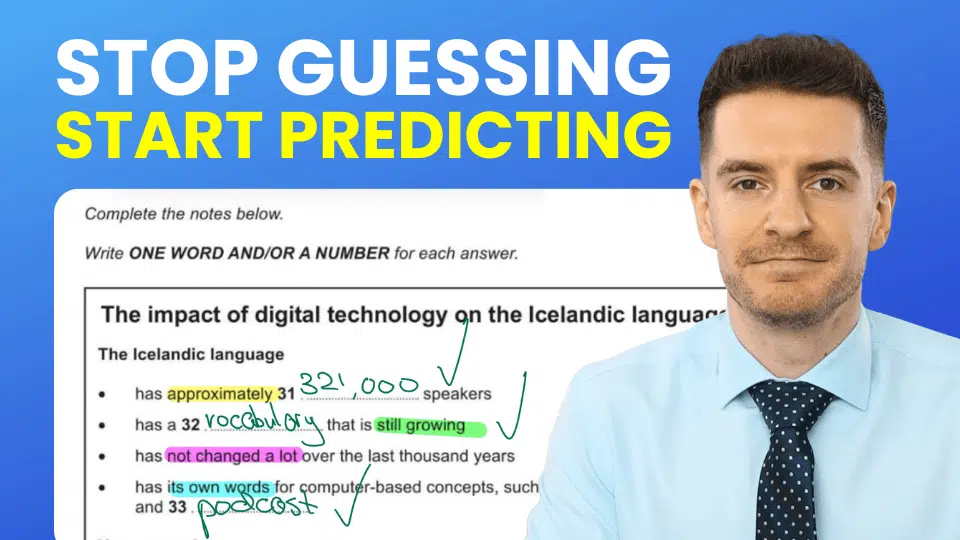
IELTS Reading Passage 3 Practice (The HARDEST Passage)
In this lesson:
✅ How to complete IELTS Reading Passage 3
✅ How to answer IELTS multiple choice questions
✅ How to answer IELTS summary completion questions
✅ How to answer IELTS matching features questions
✅ Strategies and techniques for IELTS Reading
✅ How to answer IELTS multiple choice questions
✅ How to answer IELTS summary completion questions
✅ How to answer IELTS matching features questions
✅ Strategies and techniques for IELTS Reading
Full transcript
Welcome to the final passage of the IELTS reading test and it’s usually the hardest. The language is more academic, the ideas are more complex and time pressure can really start to build. In this video, I’m going to walk you through a full passage three step by step, and I’m going to show you exactly how to approach some of the toughest question types you might face, especially multiple choice and matching features.
But before we get started, if you are preparing for IELTS, make sure you check out our preparation course in the description below, because it’s going to teach you everything you need to know to get a band seven or higher in every single part. All right, let’s have a look at our reading passage three on the screen. Now you can see our passage three.
It’s called technology and the Changing Workplace. Now let’s go straight down to the questions. We won’t waste any time. So here they are. Questions 27 to 30. Choose the correct letter A, B, or C. Write the correct letter in boxes 27 to 30 on your answer sheet. So the first thing that you should notice there is it says write the correct letter.
Okay. So when you’re writing your answer you just need to write the letter. You don’t need to write the full option that you think is correct. So let’s have a look at the first one. The first paragraph tells us about. So whenever you get something like this, the first paragraph, the second paragraph, that’s obviously really good because it tells you exactly where you need to look to find the answer.
Now, when you’re doing multiple choice, I would recommend that you just quickly read the options and get an overall idea of what each option is about. So let’s quickly do that. The percentage of roles that will be entirely automated by AI. Okay. Okay. Let’s look at B now. The growing influence of technology in creative industries, why workers are concerned about being replaced by technology.
And then finally, the predicted impact of AI on employment in the coming years. So in the future. So now we’ve read the options and we know exactly where to look. So let’s go up to the first paragraph and we will see if we can find the answer. So recent studies estimate that 10 to 20% of jobs around the world could either disappear or change significantly within the next decade.
So this sentence here looks like it could be talking about the future of work. So let’s keep reading. As artificial intelligence becomes more advanced. It’s being used in more industries. Okay. In manufacturing. Okay. So we’re giving an example. Smart robots are improving production speed while in offices. AI tools help companies sort through large amounts of data. Okay.
These developments, okay, suggests that workers in many sectors may need to adapt to stay employable in the changing job market. So it looks like this paragraph is talking about the impact of technology. There are a few specific examples like we’ve got here manufacturing and offices. So let’s go back down to the options and we’ll choose the best one.
So let’s start with number one the percentage of roles that will be entirely. That’s the key. Or that’s a key word there entirely automated by AI. Or it does talk about some percentages but it doesn’t say entirely automated by AI. So we can remove a next one. The growing influence of technology in creative industries. Well, it does talk about some industries.
It said manufacturing and in offices, but it doesn’t talk about creative industries. So we can remove that one. See why workers are concerned about being replaced by technology. Well, no, it doesn’t say anything about that. So we can remove see. And then let’s have a look at D. The predicted impact of AI on employment in the coming years.
Yes. That looks good because that’s what it talks about. So that’s how you should do multiple choice questions. So let’s move on to the next one now which is 28 according to the second paragraph. Again this is really good because now we know exactly where to look. What does Professor Naomi Fields. Again, this is also good because we know exactly who to look for suggest about the use of digital tools.
So again, let’s just very quickly have a look at the options. They can now complete tasks that once required. So in the past once required highly trained professionals. They are most effective in industries that involve physical work. They are limited to organizing large amounts of information. So limited to that just means only so they can only organize large amounts of information.
And the last one there is they reduce the need for human workers in factories. So let’s go back up and see if we can find the answer. Remember we’re looking for the second paragraph. And Professor Naomi Fields. So let’s scroll back up here. Get to the second paragraph. So you can see that it says her name straightaway, Professor Naomi Fields.
She says that digital tools are already transforming jobs that rely on expert judgment rather than physical labor. So what this is saying is that this is having an effect on jobs that require expert judgment or thinking, rather than or not physical labor. So it’s not affecting physical labor. Let’s just keep reading and see what else it says. These tools are now capable of learning okay from huge amounts of data that can be a that used to be carried out by specialists.
Some advanced systems now review applications. Okay. Evaluate employee performance or analyze sorry consumer behavior to help organizations make important decisions. So it’s just giving a few examples there. So let’s go back down and we’ll choose the correct answer through the process of elimination. So we will remove the incorrect answers so they can now complete tasks that once required highly trained professionals.
Well that looks good already because that’s what it was saying. So we can circle that one looks pretty good. B they are most effective in industries that involve physical work. Well, no that’s the opposite of what it said. So we can cross that one out. See they are limited to organizing large amounts of information. Well no that’s not true.
It does not say they can only organize large amounts of information. D they reduce the need for human workers in factories. Well, no, it doesn’t say anything about that. So we can cross out that last option D. So the answer there must be a. All right. So let’s move on to question 29. Now what did Professor Fields observe at the marketing company.
So again this is making it very clear what we need to look for. So that’s great. Now let’s quickly look at the potential options. An algorithm gave staff instructions about how to interact with clients. Okay. Staff began, choosing how to approach customers on their own. Okay. The company used an algorithm to monitor employee performance. And finally, managers encouraged staff to ignore digital instructions.
So let’s go back up and see if we can find that. Remember, we’re looking for Professor Fields and we’re looking for a marketing company. So let’s go back up and we’ll keep looking for the answer here. So in some situations I did it. But nope nothing there. Many companies no more reliable. No. These tools comes with challenges and I know no nothing there about a company.
Now another concern is the influence. Okay, professor fields okay. Spent more than two years studying. Here we go. The internal operations of a large marketing company. So we found our keywords. So now let’s slow down and we’ll see what the actual, paragraphs says about this topic. So it says in the past, sales staff and managers relied on personal judgment.
But during my time at the company, there’s that word algorithm, if you remember, that’s what, some of the options mentioned. So told them when to reach out to clients, what approach to take and what type of products to offer. Okay. Now let’s just quickly keep reading because we don’t know if the answer might be a bit further down.
So field explains that the system are often created by outside developers. That might be important. Ends up holding most of the knowledge. Okay. Over time, people start relying too heavily on what the systems tell them. Learning to see things through, it’s through its perspective. This growing independence can prevent workers from trying new things that are the okay fields in our team.
Even noticed finding ways to manipulate the system so that could be important as well. And then it sort of goes onto a new topic. So let’s go back to the question now and we’ll, choose the correct answer. So a number oh sorry. Letter A, an algorithm gave staff instructions about how to interact with clients. Well yes, the algorithm did do that.
So we can circle that. That looks good. B staff began choosing how to approach customers on their own. No. Didn’t say anything about that. It said the opposite. See the company used an algorithm to monitor employee performance. Well, now, it doesn’t say anything about monitoring. You know how the employees went or what they were doing. And finally, managers encouraged staff to ignore digital instructions.
Well, I do remember seeing the word manager, but it didn’t say anything about encouraging staff to, you know, not follow or yeah, ignore digital instructions so we can cross that one out. So it looks like 29 is a let’s move on to 30. In her recently published study, Doctor Olivia Chen okay. Fantastic. It’s telling us exactly where to look.
We need to look for Doctor Olivia Chen, and we need to look for her study. So let’s quickly look at the options. A argues that job losses are unavoidable during times of technological change. Okay claims that automation will create more problems than it solves. Okay illustrates how job losses can be handled. Okay. Suggests that governments are already doing enough.
Okay, so governments already doing enough to protect workers. So let’s go up and let’s see if we can find this study by Doctor Olivia Chen. So let’s start here. So situations like this. No fields. No okay. Professor Daniel Ray is an economist. No. Ray is predicts. No. Professor Ray is no no no no no. Here we go.
Doctor Olivia Chen, here she is. So, a researcher at the Institute for Economic Policy agrees that predictions that are today, she argues that, nothing about a study. Let’s keep going. Here we go. Her recently published study. Let’s keep reading, explores whether automation, this automation that was mentioned in the, options. And I will lead to widespread unemployment history shows that job losses can happen during times of change can happen.
So it’s possible. But strong policies such as can address this and reduce the impact. She adds, if automation is going to reshape jobs, I hope governments use this chance. One if you remember, one of the options was talking about governments. Let’s just quickly check this. Strengthen employment laws, create more secure, conditions for workers. Okay?
She continues, we have the tools. So we need to use them. Right. Okay. Chen’s research calls on leaders in business and public policy to act early and introduce, reform. A reform is a change, and it normally makes things better. Okay, I think that’s it. So let’s go down back to 30 and see if we can find the correct answer.
So he argues that job losses are unavoidable during times of technological change. Well Olivia Chen does talk about that. But she doesn’t say they’re unavoidable. She says they can happen. So that one is not correct. She does not say they are unavoidable. B claims that automation will create more problems than it solves. Well, she does talk about automation, but she doesn’t say it’s going to create more problems than it solves.
C illustrates how job losses can be handled. Well, I remember something about that. So let’s just quickly double check. She says, here it is. Strong policies can address this. Okay, so she’s talking about how, this problem can be dealt with or handled. So I think c looks good. D suggests that governments are already doing enough to protect workers.
Well, she talks about governments, but she does not say they are already doing enough to protect workers. So we can remove D. So there you go. They were the multiple choice questions. Now let’s move on to the next set of questions. Here they are. Questions 31 234. All right so let’s read the instructions. They say complete the summary using the list of words a to G.
Below writes the correct letter A to G in boxes 31 to 34 on your answer sheet. So note here it says writes the correct letter. So that means when you choose your answer you don’t need to write the word itself. You just need to write the letter. So as you can see here is the summary itself. And there are some blanks 31, 32, 33 and 34.
Your job is to choose the correct word from this list here. For each of the gaps. So each of the blanks. So let’s start by looking at the title. And this is really important because it’s going to help you to know where to look for the answers. The title says Digital Tools in the workplace. And if you remember, I think it was Professor Naomi Fields who was talking about this in paragraph two.
So we already know where to look for the answer. So let’s have a look at this first sentence here and we’ll talk about it. So Professor Naomi Fields has seen that digital tools are affecting occupations which require. So in the text we’re going to be looking for digital tools of course. And we’re going to be looking, for how they have been affecting certain occupations or certain jobs which require or which need.
So let’s go to the top, of the passage. I believe it was the second paragraph where Naomi talks about this. And yes, I can see it, or a digital tools. So let’s quickly have a read and we’ll see what we can find. So Professor Naomi Fields from the University of Toronto argues that digital tools are already transforming jobs.
Okay. That has a similar meaning to affecting occupations that rely on or need expert judgment rather than physical labor. So the answer could be right here, and I think it is. So if you think about, what she has or what the passage is just said, how could you paraphrase that in your own words? What’s another way to say that?
Especially this bit here relying on expert judgment? Well, when I think about that, well, I think it’s saying that it’s affecting jobs that need experience because that’s another way to say expert judgment. So now we’ve read the passage and we’ve thought about a paraphrase where we can come back down to the questions and we can choose the best answer.
So let’s have a look at them one by one. First one stress. Well, no, it doesn’t say anything about affecting jobs that require stress. Comfort. No upgrade, no experience. Yes, maybe, creativity. No. Approval? No. And dependance? No. So the best answer there would have to be experience. Now, please note I’m writing the full word just so you can see what it looks like in the sentence.
Obviously, in the real test, you just need to write the letter so we can cross our experience now because we’ve used that one already. So now let’s continue and we’ll find the next one. So it says while studying a marketing company. Okay, that sounds familiar. We’ve already looked at that before. Fields found that employees were showing an increasing.
So something is going up. Something is becoming more, something on the systems recommendations and used its way of thinking. So now we know what to look for. Let’s go back up to the passage and find that marketing company. And I believe that was towards the end of the first page. So let’s have a look. There we go.
Right there. Okay. Large marketing company. So we know where to look. So let’s have a quick read and see what it says. So Professor Fields spent more than two years, studying that are there okay. How? Employees. That was one of the key words there. So in the past, sales staff and managers did it. Okay. But during my time at the company, I saw.
Okay, an algorithm tells, the workers what to do and when to do it. Okay, let’s keep going. Fields explains that the system created by outside developers. Okay, holds the knowledge. Fair enough. People start, okay. Relying too heavily on what the system tells them. Learning to see things only through its perspective. This sort of sounds similar to the end of the sentence in the summary.
So if we have a look at that sentence, there, which starts with over time. Well, try and think about a different way to say that. How could you paraphrase that in your own words? So remember the summary said something is increasing. Well I think that’s talking about this thing here or this part here. Sorry. It says people start relying relying too heavily on debt, debt.
So maybe another word for relying could be dependance or depending. So they are depending they they need that thing or they need that algorithm or they need that system. It’s necessity for them. So let’s go back down and see if we can find the best word. So stress will no it doesn’t say anything about stress. So that’s not right.
Comfort. No, it doesn’t say that. Upgrade. No creativity, no approval, no dependance. Yes it does talk about dependance. But it it says reliance. So we can cross that off and we can put the word dependance in there. Now always just quickly have a read after you puts the word into the space to just to check that everything’s okay.
So fields found that employees were showing an increasing dependance on the system’s recommendation and used its way of thinking. Yeah, that looks good. That looks like it fits. So let’s continue to the next one. Now, at the same time, workers, may be discouraged from using their own something which is important for coming up with new ideas. So what that saying there is that workers might not be using something and this is stopping them or it’s important.
Sorry, for them to use that thing to create new ideas. So maybe something to do with, creativity or innovation. So let’s go back up and we’ll see if we can find it. So let’s start from where the previous answer was located or which is right here. So let’s read together. This growing dependance can prevent workers. Okay.
That sounds sort of like what they said in the, summary from trying new approaches or thinking independently, which are often key or important to advancement and in innovation. So now we know that the answer is probably here. So we need to paraphrase it. We need to, explain this in our own words. So what I’m thinking is that it’s stopping, employees from innovation, like it says here.
And maybe it’s talking about creativity because it’s not allowing them to think of their own ideas. So let’s go back down and we’ll see if we can find the answer. So, let’s start from the top there. It says stress. No, it doesn’t talk about stress. And think about it. If you put the word stress here, it wouldn’t make sense as well.
Comfort. No it doesn’t talk about comfort upgrades. No creativity. Yeah, that looks good. Approval. No. So we can cross out creativity and we can put that in there. Creativity. And again just quickly check it. So workers may be discouraged from using their own creativity, which is important for coming up with new ideas. Yes, that looks good. And it sounds very similar to what we just read up above.
Let’s look at the last one now, which is 34, to stop the issues that fields witnessed, experts are working to make AI systems that users can use with greater or more so, which we’re looking for stopping something, and we’re looking for making AI systems that, might help users with something. So let’s go back up and we’ll see if we can find the answer there.
So let’s start from where we finished before which was around here they’re often key. Okay. Let’s keep going. Fields in our team noticed employees finding a way to manipulate. No. Nothing there. We’ve seen examples. No situations like this. What? Okay. So this could be important. Trying to avoid, They want to design, okay. AI tools that people can use without confusion.
So without confusion and feel at ease with. Especially, when those tools help make decisions. So now we need to think carefully. Directed. Okay, so the answer’s probably here. So let’s try and paraphrase, this bit here. So it seems like they’re trying to make AI tools that users can trust, or that users can have confidence in when they’re actually using them.
Because look here it says feel at ease. If you feel at ease, you probably feel comfortable using something. You might feel relaxed using something. So let’s go back down now and we’ll see which, word is the best choice. So again start from the top. Stress. No comfort. Okay. Maybe upgrade. No. Approval? No. So it looks like comfort would be the correct answer.
There. Comfort. Now, let’s just double check AI systems that users can use with greater comfort. Yes, that looks good. All right, so they were the completion questions. Let’s go to the next set of questions now. So questions 35 to 40. Look at the following statements okay. Questions 35 to 40. And the list of people below. Match each statement with the correct person.
A, B or C writes the correct letter A, B, or C in boxes 35 to 40 on your answer sheet. NB you may use any letter more than once. So just a few things to mention there. The first one is again it says writes the correct letter. So when you choose your answer, write the letter, not the name of the person.
Also note here it says you can use any letter more than once because if you look here, there are six questions here, but there are only three people. Okay. So you can use each, letter for each person more than once. Now when you get this type of question, I recommend that you quickly have a look at the statements.
Think about how to paraphrase them, or think about how to say them in your own words. Then start with the first person. Find out what they say. Then go to the second person and the third person. So let’s do that right now very quickly. Let’s look at 35 workers who have a less traditional career path than before. Okay.
Rules should be changed in order to make employees, sorry to make sure employees are treated fairly. Sorry. Let me just highlight the key words. A less traditional career path. This one here. Rules should be changed. Employees treated fairly. Changes in technology have caused job cuts in the past. So the key words there will be changes in, technology caused job cuts past.
Next one, people need to consider, how AI affects jobs. Okay. Next 139 more automation. Okay. Will not necessarily reduce, the total number of jobs available. And last one, the 40 AI offers various advantages that make it attractive to companies. So obviously, one of the key parts there is AI advantages and attractive to companies. So now we’ve quickly, had a look at the statements.
Now we can start with the first person. And the first person is Naomi Fields. So let’s go back to the very top of the passage and we’ll quickly see what she says. Because if you remember, I believe the first mention of her was in paragraph two. Okay. So let’s quickly have a look at what she says. She talks about transforming jobs.
We’ve had a look at that before. The tools are capable of learning. Okay. Fair enough. Some systems review applications. Fair enough. Okay. In some situations, AI and digital tools are proving to be more effective in people. Okay. Many companies are drawn to them. Let me highlight that many companies are drawn to them because if you remember, one of the statements was something about, companies and advantages.
So this could be, where one of the answers is they bet they believe decisions made by machines are more reliable, and they’re looking to lower costs and increase performance. Well, they’re two advantages. So it looks like Naomi is the person who has said this. Now, let’s keep going. These tools come with challenges, too. Okay. If software does this today, in the past, people learned quietly, okay.
Without that kind of exposure. Okay. Nothing really important. There. Another concern is the influence. Okay. Spent more. Two years. Did it? Okay. But during my time, I saw the algorithm. Okay. Fields explains that the system created by outside developers. Okay. People rely too heavily. Yep. It’s growing dependance. Okay. We’ve already had quite a good look at that.
So we can keep going. Fields and our team even noticed, employees finding a way to manipulate it. Okay. Okay. Nothing important there. Situations like this they’re trying to avoid. Okay. For now, fields says you need to think carefully. Okay. If you remember, there was a question which said something like, people need to think about. I can’t remember what it said.
The the problems with AI or something like that. So this could be it, this new era and technology present, particularly when it comes to professional expertise, job responsibilities in control in the workplace, and then it goes on to the next person. So let’s quickly go back down and we’ll see which, statements relate to Naomi. So first one less traditional career path.
No, it doesn’t say anything or she didn’t say anything about that. Rules should be changed. No, doesn’t talk about that. Changes in technology have caused job cuts in the past. No, 38 people need to consider, how AI affects jobs. Yes. That was the one we saw last. Okay, so we can put a there for Naomi. Number 39.
More automation. We’ll know there was nothing, about that. AI offers advantages that make it attractive to companies. Yes, because we found that in the file on the first page in one of the. I think it was the third paragraph. So, we can put a there. So we’ll cross off 40, cross off 38. So we’ve done Naomi.
Now let’s move on to Daniel Reyez. So let’s go back up. And you see we’ll see if we can find where he was I believe he was on the second page. There we go. Okay. Daniel Reyes, an economist, believes the idea of a straightforward career path. Okay, that could be something about. I think it was the first one which talked about, not not having a traditional career path, something like that.
So the old model, did at that of the there is no longer realistic. Okay. Surveyors predicts that future workers will have several career shifts. Okay. So it looks like, this will be the answer for number. I think it was the first one. 35. He describes this as a part of a flexible journey to do okay when it comes to automation.
Okay. There was a cool, statement which talked about automation. Professor Ray is believes that many concerns are based on a misunderstanding. Okay. People often assume that the number of jobs stays the same. Sorry. He says, but that’s really true. Okay, if in 20 years that. Okay, he just gives some details and then it goes to Olivia Chen so we can go back down and we’ll see which statements relate to Daniel.
So let’s have a look at the first one. Workers. We have a less traditional career path than before. Yes absolutely. So he can be there. He definitely talks about that. Rules should be changed. No changes in technology have caused job cuts in the past. No, more automation will not necessarily reduce the total number of jobs available. Yes, he does talk about that.
So we can cross off 35 and we can cross off 39 now. And we’ll take, Daniel Ray is as done now if this was the real test and, you know, you’re about to run out of time. Well, for 36 and 37, you could just quickly. Right. See, but if you do have time, just quickly check. Because when you’re under pressure, when you’re trying to do things quickly, you may make mistakes.
So just quickly check. And that’s what we’ll do now because this is obviously not a real test. And we don’t have the issue of time pressure. So let’s have a look at Olivia chan. What did she say. So let’s go up here. Here we go. So let me get my highlighter okay. So Doctor Olivia Chen did it. Add to the predictions about mass unemployment are often exaggerated or maybe not 100% correct.
It’s not technology that takes jobs. It’s outdated policy is okay. It’s not technology that causes job losses. Okay, let’s keep going. She talks about automation as well. Okay. I will lead to widespread unemployment. History shows that job losses can happen during times of change, but strong policies such as retraining can address this. Okay. She adds, if automation, automation is going to, reshape jobs, I hope governments, okay can use this chance to strengthen laws or maybe change laws to create more secure conditions for workers.
Well, that was what what one of the statements was about. So I Chen’s research, calls on leaders in business and public policy to act okay, to do something to introduce reforms. We talked about that. That’s when you change something normally for the better, workers rights, fair wages and ensure the benefits that, okay, the possibilities offered are incredible.
Yeah. No no no no, the changes, this major shift could completely redefine how we work, live and communicate the reality there. Okay, so let’s go back. And let’s have a look. Say rules should be changed. Yes, she definitely says that because she talks about reform and strengthening, things. And 37 changes in technology have caused job cuts in the past.
Yes, she did talk about that. So that was passage three. If you haven’t seen the lesson for passage one, you can check it out right here. And passage two is right here. Thanks for watching. Take care and keep studying hard.


More lessons for you


Free IELTS PDF:
5 Mistakes Stopping You From Band 7+
Learn from an IELTS examiner how to fix these mistakes – plus get weekly IELTS lessons to your inbox.
IELTS Band 7+
Preparation Course 🚀
- Learn strategies for every part
- Get band 7+ fast with our method
- Avoid big mistakes
Improve Your IELTS Speaking in Minutes
Get our eBooks with 100s of common IELTS Speaking questions with band 7+ answers so you know exactly what to say.
Hot Deals 🔥

IELTS Speaking Part 1: Questions and Answers (eBook)
Get 5% off