
IELTS Listening Practice: Windmills (With Answers & Explanations)
In this lesson:
✅ IELTS Listening Practice
✅ How to handle note completion questions
✅ Answers and explanations
✅ Strategies
✅ IELTS Listening Part 4
Full transcript
Today’s listening practice topic is windmills. We’re going to focus on note completion questions in this lesson. First I’m going to show you the questions and we’ll quickly talk about how to handle them. Then you listen to the audio and try to complete the answers. And finally I’ll go through each answer one by one and explain why it’s correct.
All right. Let’s get started and have a look at the questions. All right. Here are the questions. Let’s have a read part for questions 31 to 40. Complete the notes below. Write one word only for each answer so that there one word only is very important. If you write two words or more than two words, your answer will be incorrect.
Now, when it comes to note completion questions, there are two things to remember. The first thing is when you’re listening, you should follow along with all of the dot points. So you should listen for this point here. And at the same time, know what the second point is? So this one talks about windmills have been used for hundreds of years.
So you should have that in your mind. And you should also have the next point in your mind. And the next point is about windmills were created two. So why were they created. So if you have two of these points in your mind at the same time, it won’t matter if you miss this first one because you will be ready for the second one.
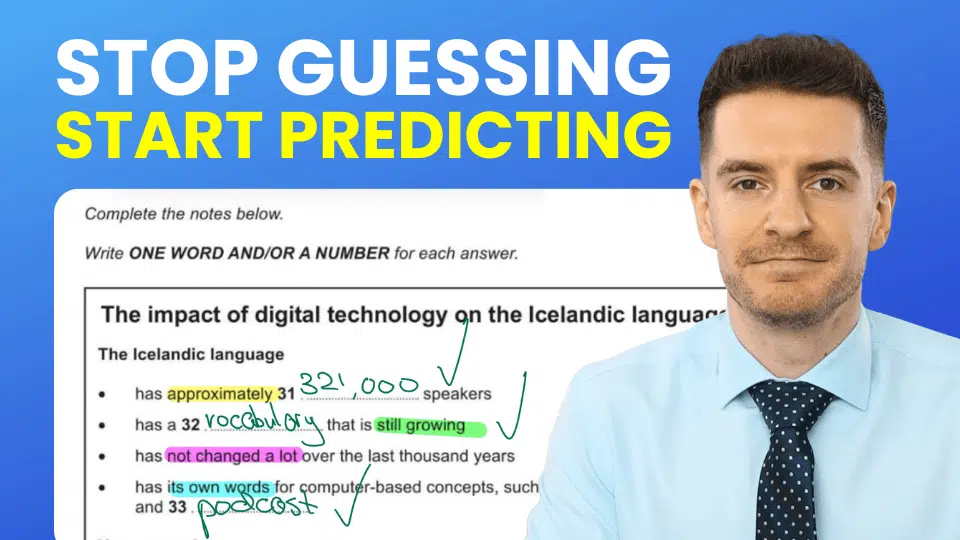
The next thing you should do when it comes to this type of question is predict the answers. So let me show you what I mean. If you look at 31 it says windmills were created two something. What normally comes after two. Would you have a noun there? No. What about an adjective? No. Probably not. Normally after two you would have a verb.
So now you know you need to listen for a verb that’s going to help you to know what to listen for. So let’s have a look at all of the other ones. They were adapted to handle different something. Well, different is an adjective. So after an adjective, we would normally have a noun. Number 33 a range of well after of.
We also normally have a noun. Low levels of. Well we’ve got of again. So we’d probably need a noun. There. They were the first four questions. Let’s move on now and have a look at questions 35 to 40. So let’s start with 35. As you can see we’ve got windmills were mostly used two. So again we’ve got two.
Therefore 35 will be a verb. 36 often gave people something. Well, that could be a noun, because if you give something, it has to be a thing. And a noun is a thing. Some something were supplied power. Well, after some, we normally have a noun as well. Okay, let’s move on to 38. Were able to collect extra something?
Well, if you collect something, you collect a thing. And a thing is a noun. 39 something were used. Well, again, you would probably need a noun. And note here we’ve got word. So here we would need a plural noun. So I’ll just give you an example. Animals were used instead of windmills. Animals is a plural noun. And finally the last one became two.
Something to look after after two with a double. Oh, not a single. So we would need an adjective, for example, to hot, to cold. All right, so now you know how to handle these questions. I’m going to put the audio on. So get ready and try to get as many answers correct as you can. Good luck. 3 to 1.
For my presentation today, I’m going to talk about the history of windmills, which have been used for centuries to harness the power of the wind. I recently visited a historical site where several old windmills have been preserved, and I had the chance to observe how they were constructed and operated in the past.
The earliest known windmills date back to the 9th century in Persia, where they were used to grind grain into flour. These early windmills had vertical sails made from reeds or wood. It’s believed the idea for using wind to generate power developed out of a need to automate specific food production processes and reduce manual labour. Over time, the concept spread across the Middle East and into Europe.
As windmills reached Europe, they began to change in design to suit the varied climates there. By the 12th century, horizontal-axis windmills became common, especially in countries like England and the Netherlands. These new windmills were more efficient because their sails could be adjusted to capture wind from different directions. Some builders even spent their time trying out many kinds of materials to see which ones improved performance the most. Over the following centuries, designers continued to refine the structure and increase the amount of power each windmill could produce.
Traditional windmills were typically constructed from stone or wood, with large sails attached to a central rotating shaft. This simple yet effective design allowed the energy of the wind to be converted into mechanical power, which was used for a variety of daily tasks. Many early windmills were well maintained because they were essential for farming and food production, which explains why some have survived for hundreds of years. In regions with dry climates, the lack of moisture also helped to preserve the wooden parts of these windmills and keep them strong and usable, even up until present times.
In many rural communities, windmills became central to daily life, especially in areas where farming was the main source of income. Their most common role was to grind grain into flour, which saved people countless hours of hard manual labour. As the need for water increased, some farmers adapted windmills to pump water for crops. This made it possible to farm land that had been too dry in the past. These changes didn’t just help farmers grow more food. They also allowed communities to grow and become more stable, with more families choosing to settle in the area. Because windmills provided such important services, the people who owned them often had influence in their local area and were well liked. In some places, the windmill even became a meeting place where people gathered to exchange news and offer help to their neighbours.
As time went on, windmills were adapted for a wider range of important uses. Besides grinding grain and pumping water, they sometimes powered small houses or helped to cut wood. Builders gradually improved the design, adding clever features that let the sails turn automatically to face the wind. Some windmills were even built with extra sails to capture more energy. These changes made windmills more efficient and allowed them to work well in different weather conditions. Some of these early designs are still seen in use today.
However, the use of traditional windmills eventually declined. Why did this happen? Well, several factors contributed to the change. As new technologies developed during the Industrial Revolution, different types of engines began to replace wind power. These machines were more powerful and easier to use, especially in poor weather. Maintaining windmills also became extremely expensive, and many were abandoned when they were no longer worth the cost. Changing farming methods played a role too. Larger farms needed faster and more efficient equipment than windmills could provide. But the idea of using wind for energy didn’t disappear. It inspired the creation of modern wind turbines, which now produce electricity in many countries.
So now I’d like to show you some examples of…
All right. So I hope you found that quite easy. And I hope you got most of the questions correct. Now, let’s quickly talk about the answers and why they were the answers. Let’s start with question 31. Windmills were created to something certain tasks. Okay. So this one was about why were windmills created? And the answer there was automate because it says that it’s believed the idea if you’re using wind to generate power developed out of a need to automate specific food production processes.
Okay. So why were windmills created? Because they were needed to automate specific, food production processes. Let’s move on to 32 now, which is in Europe. The design was adapted to handle different something in the region. So we’re looking for Europe. And the design being changed to handle something. The answer there was climates. Make sure you have an S or had an S when you wrote your answer.
This one was pretty simple. It talks about Europe. Europe. They began to change in design to suit the varied climates or the different climates. There. Moving on to 33, a range of something were tested to make windmills, more effective. So remember, we were looking for a noun, and we’re looking for a noun that was tested or some things that were tested.
And the answer there was materials. It talks about builders spend or spending their time trying out many kinds of materials. So trying out different kinds of materials just means testing. And then it talks about why okay to make windmills more effective. And that’s what it says here to see which one’s improved performance the most. Let’s move on now to question 34.
In some areas low levels of or not much. Something helped. Old windmill parts stay in good condition. Well, the answer for this one was moisture because it says, well, the speaker said the lack of moisture also helped to preserve the wooden parts that the dead. Moving on to 35, windmills were mostly used to something grain. Okay, so this one’s all about why were windmills used most of the time?
What was their main purpose? The answer for this one was grind because it says or the speaker said their most common role was to grind grain into flour. So pretty simple that one there. Let’s move on to the next one now, which was which is 36. Owning a windmill often gave people something, so we needed to listen for something about owning a windmill.
And what was the result of that? What did they get? Well, the answer there was influence. It talked about windmills. And then it said the people who owned them often had influence in their local area and were well liked. So that was the answer for 36. Moving on to 37, some something was supplied power. So the answer for this one was houses because it says besides grinding grain and pumping water, they sometimes powered small houses.
So they sent power or electricity to small houses. And make sure you have that as there okay houses. If you just write house in the singular. Unfortunately the answer will be incorrect. Let’s move on now to question 38. So this one talks about windmills with additional sails. They could collect extra or get extra or generate extra. So we’re looking for a noun here.
The answer was energy. Okay. Talks about some windmills were even built with extra sails. Additional sails to capture more energy or collect extra energy. Let’s move on to 39. The second last question. So this one says something were used. And remember, we’re looking for a plural noun here. The answer is engines. It says different types of engines began to replace wind power.
And look here we’ve got an S. Okay. Engines. So that’s a plural. So that is the answer. Engines. And again make sure you write your s very very important. And you see here in this question it says were used instead of windmills. Well here it says replace wind power. So different words but very similar meaning. And you should know by now that when it comes to the listening test and even the reading test, you’ve got to be very good at paraphrasing and understanding the meaning of what the speaker or the writer is saying.
All right. Let’s look at the last question now. Question 40. Windmills became two. Something to look after. So we were looking for an adjective here. And the answer was expensive. The speaker said maintaining windmills also became expensive and many were abandoned. That that that. So here are the answers. One more time. Just check how many you got correct.
I hope you got at least eight. That will be a really good score. Comment down below and let us know how many you got right now. If you’re interested in learning how to understand more in the listening test. Check out this video right here. Thanks for watching. Take care and all the best with your studies.


More lessons for you



Free IELTS PDF:
5 Mistakes Stopping You From Band 7+
Learn from an IELTS examiner how to fix these mistakes – plus get weekly IELTS lessons to your inbox.
IELTS Band 7+
Preparation Course 🚀
- Learn strategies for every part
- Get band 7+ fast with our method
- Avoid big mistakes
Improve Your IELTS Speaking in Minutes
Get our eBooks with 100s of common IELTS Speaking questions with band 7+ answers so you know exactly what to say.
Hot Deals 🔥

IELTS Speaking Part 1: Questions and Answers (eBook)
Get 5% off