
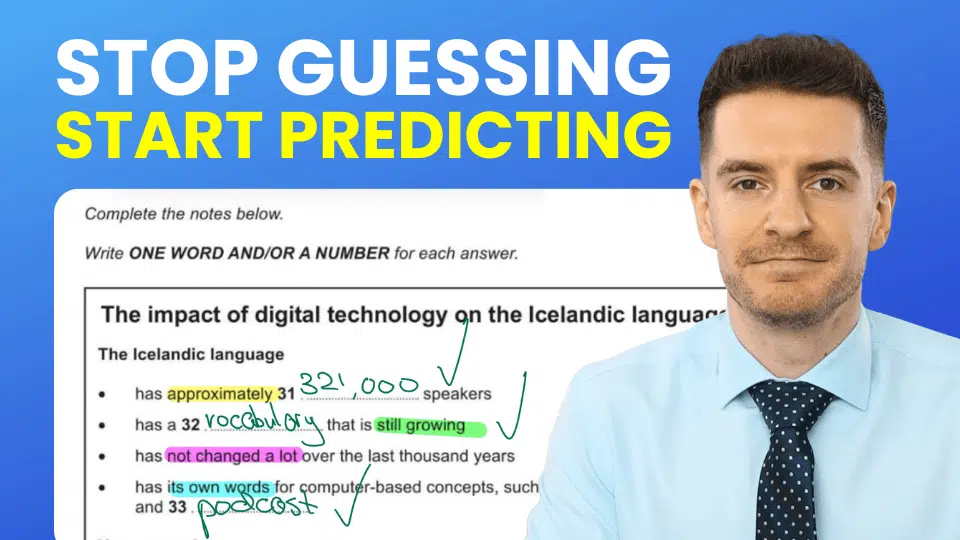
How to Improve Your English Speaking Fast (For IELTS)
In this lesson:
✅ 10 tips for improving your English speaking skills
✅ Simple strategies to improve speaking
✅ How to get a better speaking band in IETLS
✅ One simple question you need to ask yourself
✅ Why a lot of students never improve
Full transcript
If you want to improve your speaking skills for IELTS, you need to focus on the right things. So in this lesson, I’m going to show you seven simple ways to improve your overall speaking skills. And the best thing is, these are very small things that you can start doing today. And if you’re serious about getting a high score in the IELTS test, make sure you check out our complete IELTS preparation course.
It’s going to show you how to get band seven or higher in every single part. And it’s being created with the help of a former IELTS examiner. So you’ll learn secrets that only examiners would know. The link is in the description. All right, let’s get started and improve your speaking. So the first thing you need to do is ask yourself one question.
Before you even try to improve your speaking skills. You need to know what your weaknesses are and what to focus on. And to do that, you can ask yourself this one question. What three things make me sound not like a native speaker? Let me read that one more time because it’s really important. What three things make me sound not like a native speaker?
Most students never stop to think about this, and it’s one of the reasons that their speaking doesn’t improve or doesn’t get better. So you now you might be thinking, well, how do I know why I don’t sound native? Well, it’s pretty simple. You record yourself speaking English. You could tell a story. You could shadow a native speaker and repeat what they say.
Then you need to compare yourself to native speakers. And that’s the important thing, because you need to listen very carefully for differences in pronunciation, vocabulary, and grammar. If you do this and you know why you don’t sound like a native speaker, you can focus on those things and improve. But most students, they do the opposite. They never think about this, and they never focus on their weaknesses.
The first one is pronunciation and stress. This is the biggest one that I see most often. And the most common issue is students not pronouncing words correctly because they use their own sounds from their own language to speak English. Apart from that, just speaking English with no stress and speaking like a robot is another big issue. The second main issue is word choice.
Most students just use very basic words when they are speaking in the IELTS test. But to get a high band score for vocabulary, you need to use a less common vocabulary. Another issue is just using synonyms. When you don’t fully understand the meaning. Now the next one is using very easy or basic grammar and making a lot of mistakes to get a high band score for grammar.
You need to use a wide range of grammar and not make basic mistakes, like saying things like he go to work instead of saying he goes. The next thing you need to do is think in English. One of the biggest things stopping you speaking fluently is that you’re still thinking in your native language before you speak English. So here is what most students do.
Firstly, they think in their own language. They create the sentence or idea in their own language first. Then step two is they translate to English. So they mentally translate that sentence word by word in their head. And then the next thing they do is speak English. So finally they say it out loud in English, but it often sounds unnatural, slow, or incorrect.
And that’s why you shouldn’t translate to English, because it often makes your English very slow. And a lot of the time it will be incorrect or unnatural anyway. So how do you start thinking in English? Well, I’ve actually made a full course on this, which you can find on our website. But here are some basic tips. So the first thing you need to do is name things around you in English.
So what I mean is look around you and name whatever you see in English in your head straight away. Try not to let your own language come into your head. Try to turn off your brain when it comes to your language. So have a look at this picture right here. What do you see? Just think of some basic words.
Well I see. Bed. Pillow. Window building. Floor light. What about this one? I think man. Woman. Food. Fridge. Clock. What about this one? What words pop into your head straight away in English? Well, for me, I see grass, people, bicycles, trees, leaves, walking. So this is a great activity you can do anywhere, any time. Now, after you start naming things, you can take it to the next level and actually make sentences.
You can make short and long sentences in English. You can make those sentences about anything. What you see, how you feel, or just tell a story. But the important thing is you need to be making correct sentences. Because if you make sentences and they are incorrect and you do that again and again and again, well, you’re not going to improve.
So make sure you check what you’re saying is correct. So have a look at this picture again and try to make some sentences, whether they are short sentences or longer sentences. So the first thing I think about is that this room looks very modern. So that’s one short sentence. Another thing that I think about is that there is a city outside the window.
Another thing that I think of, and this is a longer sentence, is that it’s a very cozy bedroom that appears to have been designed and put together very well. So that’s another great thing you can do. And again, you can do that anywhere, any time. Now the next thing you should do is use an English to English dictionary when you need to know the meaning of a word.
This avoids going through your own native language and it helps you to learn real definitions. And that’s very important. You need to learn the correct real definition in English. Now the best, English to English dictionary I’ve found for language learners like you is the Cambridge Language Learners Dictionary, because it’s designed for people who are learning English, not native speakers.
The next thing you need to do is learn pronunciation. After doing thousands of IELTS speaking tests, I can tell you that pronunciation is definitely one of the biggest issues that stops students from getting a high band score in speaking. But why is pronunciation so important? Well, the first reason is it helps people understand you easily and clearly. So when your pronunciation is clear, people don’t have to listen very hard to understand what you’re saying.
The next thing is it makes you sound more natural. Good pronunciation helps you speak the way that native speakers do. Now the next thing is it reduces the chance of miscommunication. So if your sounds and stress are not right, it can totally change the meaning of what you’re saying and it can make you hard to understand. So what should you focus on if you want to have really good pronunciation?
Well, the first thing is correct pronunciation of English sounds. This just means learning the sounds of English properly, especially the ones that don’t exist in your language. So on the screen right now, you can see the International Phonetic Alphabet, which has all of the 44 sounds of English. So I really recommend that you learn this and learn to pronounce all of these sounds like a native speaker, because then you’re going to be able to pronounce all English words very clearly.
Now the next thing you can focus on is sentence and word stress. Knowing which words to stress or which sounds to stress can completely change how natural and clear your sentence sounds. Apart from that, you can think about or focus on your rhythm and intonation. This is the music of English. So how your voice goes up and down, and it helps to make your meaning clearer and makes you sound natural.
Because a big part of English pronunciation is actually rhythm and intonation. And finally, if you really want to sound like a native speaker, you should focus on connected speech and weak forms. Native speakers don’t say every word separately. They link words and sometimes even don’t say certain sounds. And you should copy that if you want to sound more fluent and more like a native speaker.
The most common pronunciation score is normally about 5 or 6. And if you focus on the things that I just showed you on the previous slide, you can definite get your pronunciation band score up to seven or maybe even eight. The next thing you need to do is know what a good answer sounds like. If you’re watching this video, you probably want to get a high band in IELTS speaking, right?
But have you ever actually looked at what a high level answer sounds like? Well, how can you improve your IELTS speaking if you don’t know what good speaking sounds or looks like? That’s exactly why I created a set of ebooks with questions and high level answers for each part of the speaking test, so you can see exactly what high level answers look like.
So you yourself can give high level answers. The link for these books is in the description below. So let me show you one example that comes from our ebooks. The question here is what’s the first thing you do in the morning when you wake up? This would be a part one speaking question. And it looks pretty simple, but let’s have a look at how to give a high level answer.
So to start, we could say something like as soon as I wake up, I usually spend a few moments in bed just planning my day before I get the ball rolling. So you can see here at the end of the sentence, we have got an idiom get the ball rolling means to get things started. Now after that, we could say I find that this helps set a positive tone for the rest of the day.
So you can see there that the first sentence is a complex sentence. It’s a longer sentence. Now the second sentence is a more simple sentence. It’s a bit shorter. And this is important to get a high band score when it comes to grammar. You need to show the examiner that you have a wide range of grammar. After that, I get up and start my morning routine, which typically includes a refreshing shower, a healthy breakfast, and a brief exercise session to get my heart pumping.
So, to finish off the answer, we’ve got a longer sentence and again, it’s a more complex sentence. And note here that the words in the bold are more higher level vocabulary. Most lower level students wouldn’t use them. So for example, with the word brief. Well, that simply means quick or short. So that was just one question and answer from our e-book.
Each e-book has 50 topics with answers, so you can be completely prepared for any question that you get in the speaking test. So make sure you are always looking at examples of high level answers when it comes to speaking, because it’s going to show you what type of vocabulary you need to use, what grammar structures you need to use, and just most importantly, how native speakers actually speak.
The next thing you can do to improve your speaking skills is to learn sentence patterns. But what exactly is a sentence pattern? Well, the most simple way to think about it is it’s the basic structure or order of words in a sentence. So it shows how to arrange the subject, verb, object and other parts to make a sentence that is clear and correct.
And that’s the important thing. It shows you how to make correct sentences. So what that simply means is it shows you which words to put where and which type of words to use. And that’s really important because it helps you to speak more naturally, because you don’t have to stop and think. You just follow the pattern without thinking.
And that’s one issue that a lot of students always have. They always have to stop and think about which word to put where. But if you know the patterns, you don’t need to think about that and you will know how to make correct sentences. So let me give you an example. Have a look at this sentence and think about what is the pattern here.
What do we need. What do we use. Well if you look at the first word that is the subject I, I is the subject. Next we have, have or has what do we have next? We have seen what is seen. Yes, it’s a verb, but what type of verb? Correct its verb three or a past participle. And then at the end, we’ve got the movie.
What is the movie? Well, that is the object. This is the thing that receives the action. So now you know that pattern. You can make lots of other different sentences with that pattern. Subject plus have or has plus verb three plus object. So let me show you some examples. Here is the first one. She has visited Paris. So we’ve got the subject.
But this time we’ve got has. Then we’ve got the three which is visited. And then we’ve got Paris at the end. Here’s one more. We have finished a homework. So again we’ve got that same structure. So if you notice, if you practice this again and again and again, you’re going to be able to make it correct sentences just like this without even thinking about it.
So now let me show you a few more different patterns. So I’m going to show you some patterns. And then an example. Here’s the first one. Very basic one. But a lot of students get this wrong. The pattern is subject plus verb one for example. I agree, but a lot of students say I’m angry or I am angry.
But with this pattern, we don’t need the verb to be. Here’s another one subject plus verb to be plus verb I in g. Here’s an example. He is running on the treadmill. On the treadmill is optional. We don’t need to say that. So you can see with this one we’re using a verb I ING, and we have to use the verb to be before it.
If you know that if you know this pattern, you’re going to be able to make correct sentences with this structure. And here’s one more there verb to be plus a or n plus noun. So for example there is a book on the table. So make sure you learn your sentence and grammar patterns. It’s going to make a big difference in how well and how naturally you speak English.
Now I’ve actually made a course on this topic. So if you’re interested, have a look at the link in the description. Another thing you can do is shadow native speakers. One of the best ways to sound more natural when speaking English is to copy native speakers. Word for word, sound for sound. This is called shadowing. So how does shadowing work?
Well, you can start by finding a short clip of a native speaker. It could be a YouTube video or a podcast, or even a movie scene. The most important thing is that it’s a native speaker speaking naturally at a normal speed. Then you should play the clip and try to say the words at the same time as the speaker, or just after them.
You’re not just repeating, you’re trying to copy them and sound exactly like them. Focus on their pronunciation, intonation, and rhythm. That’s what makes you sound more natural. Not just saying the same words. Now, when you copy native speakers, you learn how they speak their speech, their tone, their pronunciation. And this is going to help you speak more clearly and sound more natural.
So now you know what shadowing is. It’s time to do some practice. I’m going to say three sentences and they’re going to get longer and longer. And for each sentence, I’d like you to repeat after me as quickly as you can. And remember, try to sound exactly like me. Are you ready for the first one? Here we go.
I like to read books. I like to read books. So with that one, you probably heard two things. I didn’t say two. I said to. I like to. I like to read books. Also, you’ll notice that I stressed books because books is a very important word in the sentence. Okay, here is the next one. She always drinks coffee in the morning before work.
She always drinks coffee in the morning before work. So for that one, you would have heard I say it. Is she always. It’s like there’s a y between the she and the always. She always. Okay, let’s look at the last one. I wanted to go to the park, but it started raining, so I stayed inside.
I wanted to go to the park, but it started raining. So I stayed inside. So again, for that one, you would have noticed that I didn’t say two. I said two. So I said I wanted to. I, I didn’t say go to, I said go to. And also another thing is I said so I so why. So it’s like there’s a w between the so and the I so I so they were just three examples.
You can do this with any type of content. You find where a native speaker is speaking naturally. It’s a fantastic exercise to do. So make sure you do a little bit every day. The next thing you can do is use English in daily life. If you only use English in class or during study time, you’re probably going to improve very slowly.
The fastest way to improve your English is to create an environment that is always teaching you. So this just means surrounding yourself with English as much as possible in your free time on your phone, even during your daily routines. So how can you do that? Well, let me give you some ideas. The first thing you can do is change your phone to English, because doing this will make you see English every time you use your phone.
You can watch YouTube videos in English. Make English part of your free time by watching things that you enjoy. You can follow your English speaking accounts. So even just scrolling on social media can become language practice. You can listen to English podcasts while doing daily tasks. So you don’t need any extra time for this one. You just use the time that you already have.
You can think in English when doing small things. So try describing what you’re doing or planning. For example, I’m making tea now. Use an English to English dictionary. This is going to help you to think in English. Instead of translating. You can write your to do lists or notes in English. So this is a small change, but it can build your writing skills and your vocabulary.
Next you can read signs, menus, or other product labels in English because you’ll train your brain to notice English around you. And finally, you can speak to yourself out loud, in English and with friends so you can practice speaking without pressure. That’s going to help you to improve your fluency. The great thing with all of these things is you don’t really need to take any time out of your day.
You just need to change how you do things. So now let me leave you with one final tip. Don’t just be like everyone else and watch this video and do nothing. In life you need to take action to get the benefits. So try to incorporate some of these things into your routine and you’re going to see improvement. So you’re going to get the benefits.
Now if you want to learn how to sound more natural when you’re speaking English, make sure you check out this video right here. Thanks for watching. Take care and I’ll see you in the next lesson.


More lessons for you


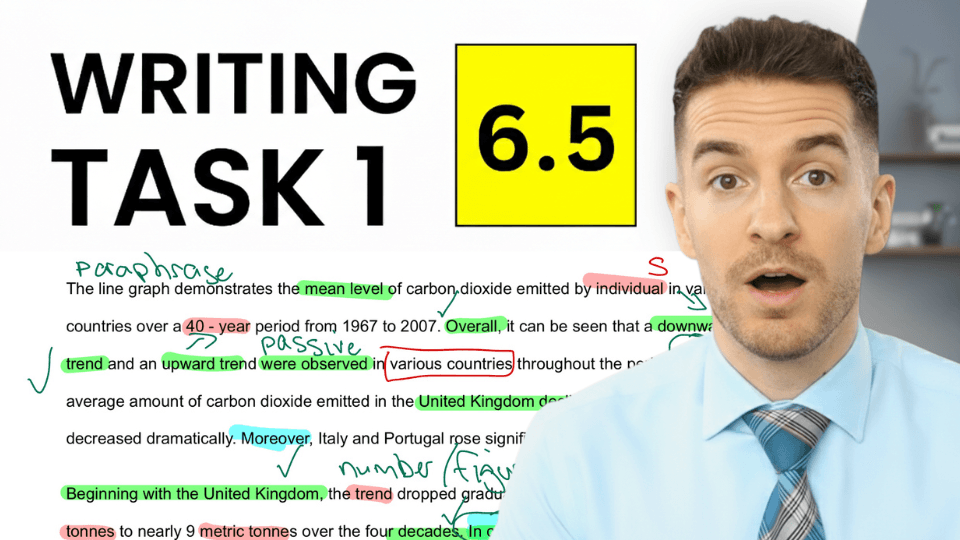
Free IELTS PDF:
5 Mistakes Stopping You From Band 7+
Learn from an IELTS examiner how to fix these mistakes – plus get weekly IELTS lessons to your inbox.
IELTS Band 7+
Preparation Course 🚀
- Learn strategies for every part
- Get band 7+ fast with our method
- Avoid big mistakes
Improve Your IELTS Speaking in Minutes
Get our eBooks with 100s of common IELTS Speaking questions with band 7+ answers so you know exactly what to say.
Hot Deals 🔥

IELTS Speaking Part 1: Questions and Answers (eBook)
Get 5% off