
9 Tips For a Band 9 in IELTS Reading
In this lesson:
✅How to improve your IELTS Reading Band Score
✅Tips and tricks to score higher in IELTS Reading
✅Basics of the IELTS Reading Test
✅What you need to do to get band 9 in Reading
✅Tips and tricks to score higher in IELTS Reading
✅Basics of the IELTS Reading Test
✅What you need to do to get band 9 in Reading
Full transcript
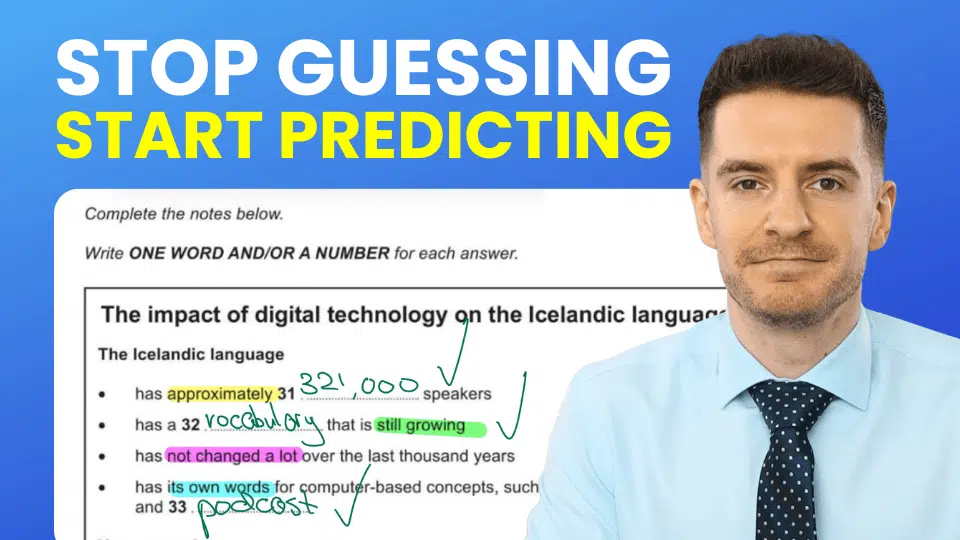
If you want a band nine in IELTS reading, you need more than just good English. You need the right strategies. In this video, I’m going to share nine tips to help you get a band nine. Find answers more quickly and avoid common mistakes. Number one understand the basics. So before you can get a band nine on the IELTS reading test, you need to understand how the test works.
You need to know the format, question, types, and timing because this is going to save you time on test day because you’re going to know what to do and what not to do. So here are some of the basics. The test is 60 minutes in total and you will have to read three passages or sections. There are 40 questions for you to answer, and you will not have time at the end of the test to transfer your answers.
Now, when it comes to the academic and general training reading tests, they are slightly different. In the first part in the academic test, you have one passage to read. Whereas for general training you will have two shorter texts to read. For the second part academic, you will have one passage to read again and general training you will have two shorter texts to read again, which will be about work.
And finally, in the last part in the academic test, you have one passage to read again. And for the general training test you will have one long text to read. Two understand the question types. There are 11 main question types in the reading test, and each one requires a different strategy to answer it in the fastest and most effective way possible.
So let’s pretend you get this question or this set of questions in your real reading test. And you’ve never seen anything like this before. Well, you would have to waste time thinking about what you need to do and how to do it. But if you know how to answer each question, type before you go into the test. You’re going to save time, and you’re going to be able to find the answers much quicker.
Three understand which questions come in order. This is one of the most important things you can do to help you know where to look and where not to look for the answers in the reading test. Now you might be thinking shame. What do you mean by come in order? Well, let me show you. As you can see, we have three questions on the right hand side and then a short passage on the left.
Let’s pretend that we’re looking for the answer to question one. And we find it here in the red rectangle at the top. Now, the answer for question two will be somewhere below that. It could be in the next sentence or in a later paragraph, but it will always come after the first answer. In this case, it’s found in the blue rectangle.
Now finally, the answer to question three will also be below that. And here it’s found in the green rectangle in our band seven plus preparation course. We look at each question type in the reading test and I show you exactly which one has come in order and which ones don’t. So you can save time and find the answers much faster.
If you want to learn a full strategy, check out the link in the description. Number four beware of traps. IELTS reading has tricks and traps to try and get you to pick the wrong answer. If you’re not aware of them, you may end up choosing the wrong answer and this is going to reduce your band score. So this is the first trap paraphrase the questions and the text will use different words, so don’t expect to see the exact same words from the question in the passage, because most of the time they will be different.
The second one is distractors. A distractor is an answer that seems correct, but it’s not. These are designed to trick you, so read carefully and don’t just choose an answer because it has the same words as the text. Now the third one is half true statements. This means when part of a statement is true, so a half true statement contains some correct information, but the other part is not correct.
So for example, the question might say most people exercise every day, but the text says a small amount of people exercise every day. So the everyday part is correct. But how many people do it is not correct. Number five is skim the passage first before you even look at the questions. I would recommend that you quickly read the passage that you’re looking at for the main ideas.
You shouldn’t spend long on this. You should not spend more than one minute, because this is going to help you to get a general idea of what the passage is about. And if you’ve got a good memory when you actually get to the questions, you might remember where certain words are in the text. Now, some people say you shouldn’t skim, but I disagree.
I think you should read the passage very quickly. And like I said, you shouldn’t take longer than one minute. Ideally it should. It should take you about 30 seconds, but it’s really up to you. Try skimming before you look at the questions and try not skimming at all and just see which works best for you. So here is a very short passage which has three paragraphs.
Just quickly pause the video and skim these paragraphs and think about what the main ideas are. Well, if you had a chance to do that, you would have seen that. The first paragraph. He’s talking about board games being a form of entertainment for centuries. So it’s just some general information about board games. The second one, well, the second paragraph is about one reason for the increase in popularity.
And then the final paragraph is about board games still face challenges. So if you quickly skim the passage, you’re going to know what the main ideas are in each paragraph. Number six, you don’t need to understand every word. A lot of students, when they’re doing the reading test, think they need to understand and read every single word in the passage.
Well, this is 100% not true. And it’s going to waste your time and cause you stress, especially when you don’t know the meaning of a word. If you do this, you probably won’t be able to finish all of the questions in time. So instead, you should only be focusing on the areas of the passage where the answers are located.
And if you do happen to see a word that you don’t understand, you’ve got two options. So if you don’t know the meaning of a word, ask yourself, Will knowing the meaning help me get the answer right? If the answer is no. Well, you don’t need to worry about that word. It doesn’t matter. It’s not important. Don’t waste your time on it.
However, if knowing the meaning will help you get the answer right, well, you need to guess the meaning. Try to guess the meaning by looking at the context, and that means looking at the words before and after the word that you don’t know the meaning of. Number seven time management and speed. So I always tell students about this and they don’t seem to understand.
So let me explain it very clearly. In the reading test you have 60 minutes. You have three passages you need to read, and you have 40 questions that you need to answer. That means, on average, you need to answer one question every 90s. And that 90s includes skimming the passage, reading the instructions, reading the questions, finding the answers, checking if your answers are correct, checking your spelling.
So there’s a lot of things you need to do, so you need to work quickly. But that doesn’t mean rushing and making mistakes. You should do things quickly. You should do things with speed, but you should still aim for accuracy and high quality. Eight spelling. This is one of the most common mistakes, which can often result in students losing half a band, or even more than that in the reading test, you must get the spelling correct.
It doesn’t matter if you find the correct answer. If you don’t spell it correctly, you won’t get the mark. Here are five common examples of spelling mistakes. The first one is accommodation. Accommodation needs to have double M, the second one is separate. After PE you need to have an A, not an E. The next one is receive. Receive is spelled with a c e I, not CIA occurred is another one occurred.
It needs double r and the last one is necessary. You only need one C after the first e. Number nine. If you don’t know, just guess. For a lot of questions in the reading test, you simply have to pick a letter or decide if something is true, false or not given so if you don’t know, just guess because you may get the answer right.
And if you do guess and get it wrong, don’t worry because you do not lose any marks. So let’s pretend you get some multiple choice questions like this and you don’t know the answer. Well, just guess. Just write or type a letter. You do not lose marks for wrong answers. Let me say that one more time. You do not lose marks for wrong answers.
Just knowing these tips isn’t enough. You need to practice them. The right way. If you want to step by step guide on how to answer every question, type in the reading test and how to get a band seven or higher in the IELTS test. Check out our full preparation course. The link is in the description below, and if you’re looking to improve your listening skills, check out this video right here.
See you next time and good luck with your studies!


More lessons for you

Free IELTS PDF:
5 Mistakes Stopping You From Band 7+
Learn from an IELTS examiner how to fix these mistakes – plus get weekly IELTS lessons to your inbox.
IELTS Band 7+
Preparation Course 🚀
- Learn strategies for every part
- Get band 7+ fast with our method
- Avoid big mistakes
Improve Your IELTS Speaking in Minutes
Get our eBooks with 100s of common IELTS Speaking questions with band 7+ answers so you know exactly what to say.
Hot Deals 🔥

IELTS Speaking Part 1: Questions and Answers (eBook)
Get 5% off