
9 Tips For a Band 9 in IELTS Listening
In this lesson:
✅ How to improve your IELTS Listening band score
✅ How to answer more questions correctly in IELTS Listening
✅ Common mistakes to avoid in IELTS Listening
✅ General tips and tricks for IELTS Listening
Full transcript
If you want a band nine in IELTS listening, you need more than just good English. You need the right strategies. In this video, I’m going to share nine tips which can help you to improve your IELTS listening band score. Get more answers correct and avoid common mistakes. Now make sure you watch until the very end, because you’re going to find out what might happen if you don’t check your grammar.
So let’s start with the first tip, which is understand the basics. So before you can get a band nine on the IELTS listening test, you need to understand how the test works. You need to know the format, the question types and the timing. This is going to help to save you time on test day, because you’ll know exactly what to do and exactly what not to do.
Now, when it comes to the listening test, the listening test is 30 minutes in total. There are four parts, and there are 40 different questions that you need to answer. So for each part, you will get ten questions. Now in the paper based version you will get ten minutes to transfer your answers. But please note if you’re doing the computer delivered test, you will not get ten minutes at the end to transfer your answers.
And by the way, if you’re serious about getting a band seven or higher in the IELTS test, make sure you check out our complete IELTS preparation course because it’s going to teach you how to get band seven in every part. And not only that, but it’s being created with the help of a former IELTS examiner. So you will learn the secrets that only examiners would know.
The link is in the description. All right, let’s continue with our lesson and talk about what actually happens in each part of the listening test. So let’s talk about the first part. In the first part they are normally two speakers but they sometimes might be three. And the topic in part one is an everyday common topic. So for example, something like booking a hotel.
This is very basic. It’s something that you might hear in day to day life. Part two has one speaker only. It is a monologue. The topic will also be an everyday common topic. So for example, it might be a tour of a park. Now topic three you will get normally two speakers, but sometimes three. And the topic changes in part three.
In part three you will get an academic topic. So for example, it might be something like two students discussing a historical event. Now in part four you will get one speaker. Again it will be a monologue and the topic will also be an academic topic. And an example could be something like a lecture on birds. All right. Here is tip two.
Focus on key words. Not every word. Most students try to listen to every word in the IELTS listening test. But this is not necessary. Some of the words that the speakers say won’t help you answer the question. And remember, the purpose for you is to listen so you can find the answers or get the correct answers. Apart from that, it’s you know, if you do try and understand everything, it might stress you out if you don’t understand.
And that could cause you to miss answers. And of course you don’t want that. So what should you do instead? Well, I recommend that you focus on the main idea and the key words. But what is a key word? What does that mean? Well, when I say key word, I mean a word that has important meaning. It often tells you who, what, where or when.
And it helps you focus on the right part of the audio to get the answer. So now let’s do some practice. You’re going to see a multiple choice question, and I want you to listen for the answer. It sounds pretty simple, but just try to focus on the key words from the question. So here is the question. Choose the correct letter A, B, or C what is located next to the cafe?
Is it a gift shop, B ticket booth or C bike rental? Well, let’s listen to the audio, which will be me telling you about the lakeside visitor Center in three, two, one. Welcome to the Lakeside Visitor Center. If you’re coming by bus, you’ll find the stop just outside the main gate. From there, follow the path past the fountain and you’ll see the cafe on your right.
It’s a great place to relax before exploring. Now right next to the cafe is the ticket booth, where you can buy entry passes or ask about guided tours. The gift shop, though, is a little bit further down near the exit. All right, so now you’ve listened to the audio. What is the correct answer? Well, I really hope you said B ticket booth.
So let’s quickly have a look at what I said. So now you can see the script on the right hand side of the screen. And the first half of what I said wasn’t really important. It didn’t help you answer the question because there was nothing about the cafe in that section. So if you focused on listening to every single word and trying to understand every single word, well, it wouldn’t have helped you to get the answer right.
However, if you look at the text in the green, that is where the answer, is located. Because you can see that I said cafe. And that is clearly one of the key words from the question, because you need to find out what is next to the cafe. So that was a very basic example, but I hope you can see now that it’s very important to listen to the key words rather than trying to understand and listen to every single little word.
Now, what happens if you don’t know the meaning of a word? You know, let’s pretend you’re listening to the audio and you don’t know the meaning of a word. What should you do? Well, you should ask yourself one question. We all, knowing the meaning, help me get the answer right. If the answer is no. Well, it doesn’t matter.
Don’t worry about that word. Just move on. However, if the answer is yes, well, you should guess the meaning. And a lot of the time you can do that by listening to the context and making a guess by listening to the context. All right. Let’s move on to tip number three, which is understand all of the question types.
Now there are six main question types in the listening test. And each question requires a different strategy to answer it in the the fastest and the most effective way possible. So let’s pretend that you get some questions like this in the listening test. And let’s pretend you’ve never seen them before and you don’t know what to do. Well, you’re going to have to waste time thinking about, you know, what do I need to do here?
How do I answer these questions? And the problem is, in the listening test, the answers can come very fast. They can come very quickly. And if you’re not prepared, you’re probably going to miss some of the answers. Now, if you do want to know a strategy for how to answer each of the different question types and how to get as many answers correct as possible, make sure you check out our self-study IELTS course, which is in the description below.
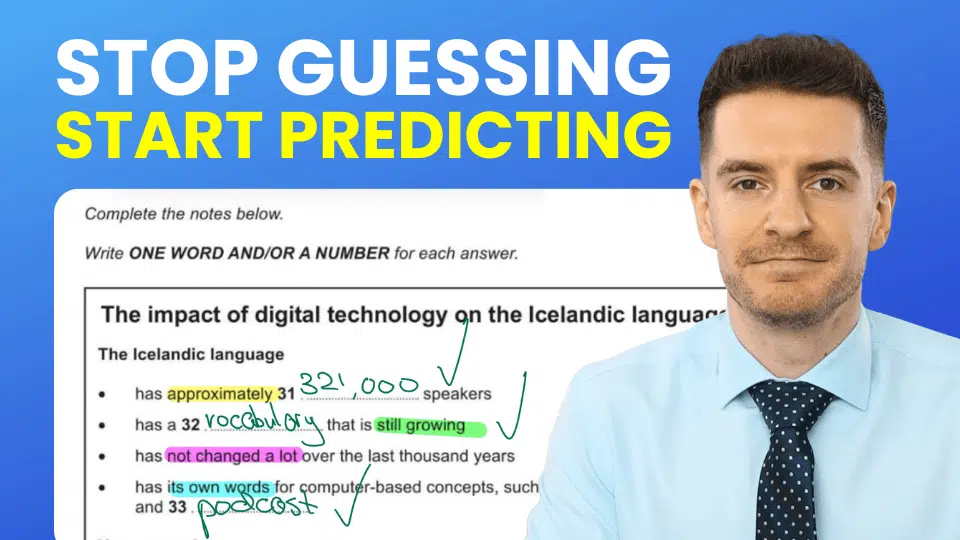
Now let’s move on to tip number four, which is. Try to predict answers even before the audio starts. When it comes to completion or fill in the blank questions, you can often guess what kind of word is missing. So for example, a number, a name, or a place. And if you do this, it’s going to help you to know what you need to listen for.
So let me show you what I mean. Now let’s pretend you get some instructions like this. Write one word only for each answer. And let’s pretend you. Your first question is this one. Well, it says the museum is famous for its ancient debt. Well, we can guess what part of speech will go in the gap or the blank.
So ancient is an adjective. So after an adjective, we normally have a noun. So we know that the answer for number one is probably a noun. So that’s what we should be listening for. Let’s look at number two. The hotel offers something. Rooms with city views. Well, a room is a noun. And before a noun we’re probably going to have an adjective.
So for number two we would need to listen for an adjective. Number three visitors must see something before entering the laboratory. So we’ve got must what normally comes after must. Would we use a noun? Must. Cat? No. Would we use an adjective? Must. Hot. No. Probably not. So we need to have a verb after. Must. So for number three, we would be listening for a verb.
Number four. The course is designed for students with a something level of English. Now we’ve got the word r. And normally after r we would have a noun. And we do have a noun because level is a noun. So now we know level is a noun. What comes before a noun. Well it’s similar to question number two. So it’s probably going to be an adjective.
Let’s look at one more example. The main topic of the lecture was the something of climate change. So we’ve got an article again we’ve got though and we’ve talked about this before. After the we normally have a noun. So if you do this it’s really going to help you to know what to listen for. Tip five listen for paraphrasing.
One of the most important skills in the IELTS listening test is listening for paraphrasing the words you hear in the audio often won’t be exactly the same as the question. So you need to listen for the meaning, not just the exact words, but what does paraphrasing actually mean? Well, it means saying the same idea using different words. It’s a way to say something in a new way without changing the meaning.
And that’s key there. You don’t change the meaning. And you can often do this by using synonyms or rephrasing the sentence. So now let’s have a look at some different ways to paraphrase the first one. And the most common one is by simply using synonyms. So if we look at this original sentence it says class and then it says very boring.
The class was very boring. Well we can change that by saying the lesson was extremely dull because lesson and class have a similar meaning, and dull can mean boring. So same meaning, but just different words. The second way is by changing the structure. She couldn’t come because she was sick. Okay, this is one sentence structure we could use to describe this situation.
Alternatively, we could say something like this. Because of her illness, she wasn’t able to attend. Okay, so we’ve changed the sentence structure and now we’re using a complex sentence. And also note we have changed sick to illness. So we have not only changed some of one of the words, but we have also changed the structure. Now the third way is by changing the parts of speech.
So the original sentence here is he gave a clear explanation. Well, we could paraphrase that by saying he explained it clearly. You can see that in the original sentence we say explanation that’s a noun. But in the paraphrased version we say explained. Well, that’s verb two. In the original we say clear. Well, clear is an adjective. However, in the paraphrase is the version we say clearly.
Clearly is an adverb. The next way is combining. So putting two sentences together, I missed the bus, I arrived late. Well, they are two separate sentences. A paraphrased version could look something like this. I arrived late because I missed the bus. So you can see that we’ve joined these two sentences together with the conjunction because and we’ve also swapped the sentences.
So we’ve put arriving late at the start and missing the bus at the end. Now here is the next method using the passive voice. They built the school in 1995. This is the active voice. Now the paraphrased version is. The school was built in 1995. So you can see here we’ve changed the grammar a little bit. And now we’re using the passive voice.
Now please note sometimes you might have a combination of these different methods to paraphrase. So maybe you might change the structure and use some synonyms. So they were just some very basic examples of how paraphrasing works. But please note that it’s not going to be that easy in the real test. Now let’s move on to tip number six, which is watch out for distractors.
A lot of students get questions wrong in the IELTS listening test because they choose the first answer they hear, which is often a distractor. So what is a distractor? Well, distractors are words or phrases in the audio that sound like the answer but aren’t. So it sounds like they’re the answer, but they are not correct. They are designed to confuse you or make you choose the wrong option.
If you’re not listening carefully. Now, in our preparation course, we look at distractors a lot and we go through plenty of examples so you can see how they work and learn how to avoid them. So you can get the highest band score possible. But for now let’s look at a quick example. So here is the question. At. Choose the correct letter A, B, or C.
The seminar will be held at the A University Hall, B Community Center or C City Library. So again I am going to be the speaker. So have a listen. 321. So originally we planned to hold the seminar in the University Hall like we did last year, but there were some scheduling issues. The library was our second choice, but it’s closed for maintenance this week.
Luckily, the community center had a room available and it’s actually closer for most people. So we’ve gone ahead and booked that instead. It will be at 3 p.m. as initially planned. So what was the correct answer? Was it A, B or C? Well, I’m not going to tell you. Comment down below. Now let’s move on to tip number seven, which is listen for two questions at the same time.
In IELTS listening, the answers can come very fast and sometimes you might miss an answer. And if you do miss an answer and you don’t know it well, then you might miss the next question as well. So to stop that happening, you need to focus on two questions at the same time. So let me show you what I mean.
If you look at question one, you can see that it’s about a problem. And question two what is that about? Well, it’s about what the two people found surprising about the models. So what you should do is, is listen for both of these two things at the same time. The problems and what David and Sarah found surprising because if you miss the first one, well, it doesn’t matter because you are ready for the second one.
So this is a very simple tip, but it can make a really big difference and help you to stop missing answers. So now let’s move on to tip number eight, which is check your grammar. So if you don’t check your grammar it could really affect your final score. For example you might lose half a band or even more.
So what I mean is if you don’t check your grammar, you might write something that’s wrong even though you understood the answer. That means you could lose marks for small grammar mistakes, even when your idea was correct. Not only that, but in some situations you might miss going up half a band. So for example, from 6.5 to 7, what I mean is, even if you’re really close, small mistakes like grammar or spelling problems can stop you from getting a higher score.
Now let me show you some examples of grammar mistakes that I have seen. So let’s pretend that the question is the reason for choosing the city. Low cost of and the student writes apartment. Well, that is wrong. The correct answer would be apartments with an S. So the mistake there is the missing s. Now the next one. The project was finally something after delays.
Well, let’s pretend the student writes complete. Well, that is wrong. The correct answer would be completed. There is a missing e d or just a D at the end. The next one. She applied for a something last year. So the wrong answer is positions. Why? Why is that wrong? Well we’ve got R and after R we need a singular noun.
So the correct answer would be position. So the mistake there is an extra s. So if you make 2 or 3 of these mistakes it could reduce your band score by half a band. Even though you knew the correct answer should be very careful. All right. Let’s move on to tip number nine, which is read the instructions. Now, just like with not checking your grammar, I have seen students lose half a band or more because they didn’t read the instructions.
So let me show you what I mean. Let’s pretend that the instruction says write one word only. Well, here are some correct answers. Library or eco friendly? Now library. Well, that’s pretty simple. That’s one word. Now, when we have something like, eco friendly, which has a dash in the middle, that’s fine. That is considered as one word for the listening test.
Now, if you wrote something like public library, well, that’s wrong, because it’s clearly two words public and library. Now, let’s pretend it’s all the instructions. Say write one word only and or a number, and you write 30. That’s correct. If you write 30 people, that’s also correct because it’s one word people. And it’s a number 30. And if you just write people, that’s fine as well because that is one word.
However, if you write many people, that is incorrect because it’s two words. The instructions say one word only and a number. So you can have one word and a number, but you cannot have two words. So there were nine tips to improve your listening band score. If you want to know how to improve your reading band score, check out this video right here.
Thanks for watching. Take care and all the best with your studies.


More lessons for you



Free IELTS PDF:
5 Mistakes Stopping You From Band 7+
Learn from an IELTS examiner how to fix these mistakes – plus get weekly IELTS lessons to your inbox.
IELTS Band 7+
Preparation Course 🚀
- Learn strategies for every part
- Get band 7+ fast with our method
- Avoid big mistakes
Improve Your IELTS Speaking in Minutes
Get our eBooks with 100s of common IELTS Speaking questions with band 7+ answers so you know exactly what to say.
Hot Deals 🔥

IELTS Speaking Part 1: Questions and Answers (eBook)
Get 5% off